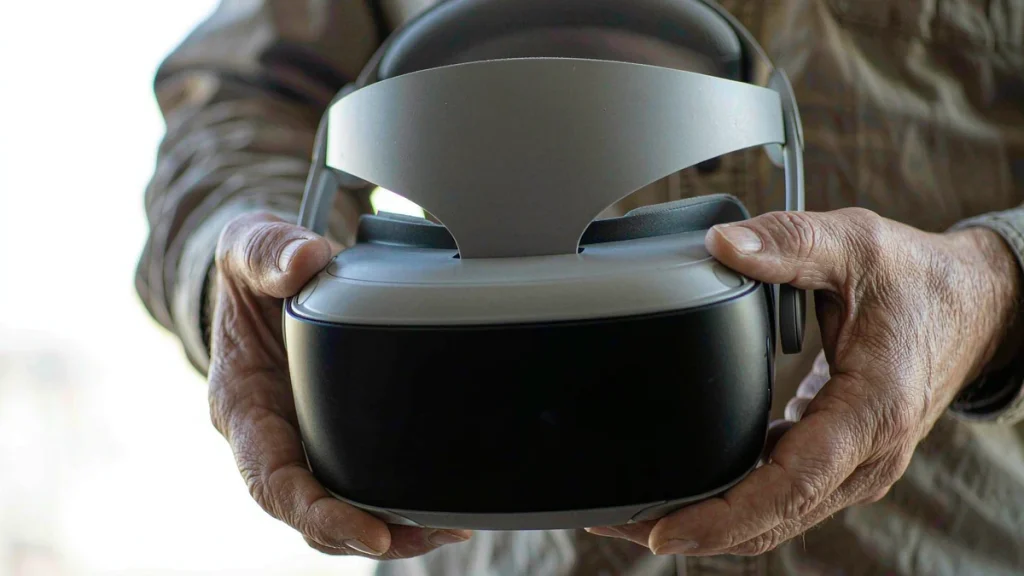
A product disappearing from its own store page reads like an obituary. It usually is not one. Sony removed the PSVR 2 from PlayStation’s direct web store this week while retail stock thinned out at several online sellers, and the immediate conclusion in most coverage was that the headset had been quietly discontinued. The gap between those two conclusions is where every practical question for an owner actually lives.
Being delisted and being abandoned are different events, separated by years of obligations.
Four reasons a first-party listing vanishes
A storefront is an inventory system with a marketing skin. Products leave it for reasons that have nothing to do with a product decision, and the same blank page can mean opposite things.
- A channel shift, where the manufacturer stops selling direct and lets retail carry the remaining units.
- A stock transition between production runs, where an old SKU is pulled before a revised one is ready.
- A regional catalogue cleanup, where a listing is removed in one territory while staying live in others.
- A genuine wind-down, where manufacturing stops and the remaining units are simply allowed to sell through.
Only the last one is an ending. Distinguishing among them takes more than a missing add-to-cart button, and a company under no obligation to announce a production change will rarely volunteer one. Owners are left reading signals, so it is worth knowing which signals carry weight.
Warranty runs on the receipt, not the listing
This is the most common misreading, and the easiest to settle. A statutory or manufacturer warranty attaches to a purchase on a date, evidenced by a receipt or an order record. It does not depend on the product still being offered for sale. A shop page going dark has no effect on a claim that was valid the day before.
What does change is the remedy. If a unit cannot be repaired and no replacement stock exists, a claim may resolve as a refund or a credit rather than a swap. That is a logistical outcome, not a loss of cover. Keep the proof of purchase somewhere that is not the retailer’s account page, since retailer order histories are themselves subject to retention policies.
A delisting ends a sale. It does not end a contract.
Accessories are a separate clock. Controllers, cables, face gaskets and lens protectors are consumables in a way the headset is not, and their availability depends on a different inventory. A headset can be fully supported while its spare cable is out of stock for a season, which is annoying but not evidence of abandonment.
What stays tied to the account
Purchased software lives in the account’s licence history, not on the shelf where the hardware was sold. Games already bought remain downloadable as long as the platform serves them, and the storefront that sold the headset is not the same system as the one that serves a licence. Conflating the two produces a lot of unnecessary panic.
Firmware is the more useful indicator. A platform that still ships system updates for a device, fixes compatibility regressions, and keeps its support articles current is maintaining it. A device that stops appearing in release notes is being allowed to coast. Neither is a press release, but both are considerably harder to stage than a catalogue edit.
Support documentation is worth checking directly. A product page that still lists troubleshooting steps, serial-number locations, and replacement-part procedures is a live commitment. A page that has been redirected to a generic help hub is a different kind of signal.
The second story is about a much older console
The same week produced a reminder that the PS3 has an expiration date. That phrasing sounds dramatic until it is unpacked: what expires is a set of services and certificates, not the ability to read a disc. A console can keep playing physical games long after its store, its online authentication, and its update servers have gone quiet.
This is the useful frame for any hardware at the end of its commercial life. Capabilities do not fail all at once. They fail in an order — online features first, storefront access next, account-dependent functions after that, and offline playback last, sometimes decades later. Knowing the order is more valuable than knowing whether a listing is still live.
For a headset, the order is slightly different because so much of it depends on a companion console and an account. A device that needs a host system to function inherits that system’s service timeline as well as its own.
If buying used, check the things a listing cannot show
A second-hand unit is a hardware purchase with a software dependency, and the inspection list reflects that.
- Confirm the headset pairs and tracks on the current system firmware before paying.
- Check both controllers for stick drift and for a charging port that holds a cable without wobble.
- Inspect the lenses under a light; scratches there are permanent and cannot be patched.
- Ask whether the original purchase record can be transferred, because it is the only route to any remaining cover.
- Verify the required cable or adapter is included, since a missing proprietary part can cost more than the unit is worth.
None of these checks require the manufacturer to still be selling the product. They require the previous owner to have looked after it. That is the honest risk profile of a delisted device: not that it has been abandoned, but that the supply of careful owners is shrinking.
What would actually confirm a wind-down
Three things, appearing together. A statement from the manufacturer, the disappearance of the product from official support and parts pages, and the end of firmware mentions in release notes. One of these is noise. Two is a trend. Three is an answer.
Until then, the sensible reading of a missing store page is the boring one: a sales channel changed. Owners should keep their receipts, download anything they care about while the servers are cheerful, and stop treating a catalogue edit as a eulogy.
Official material is the place to verify all of this rather than a resale listing. PlayStation support retains product pages and warranty terms long after a SKU leaves the shop, and Sony’s corporate disclosures cover hardware segments at a level that makes a quiet discontinuation visible in hindsight. Neither will tell you what happened to a single listing this week. They will tell you whether the platform is still being maintained.